
Payday Super begins 1 July 2026
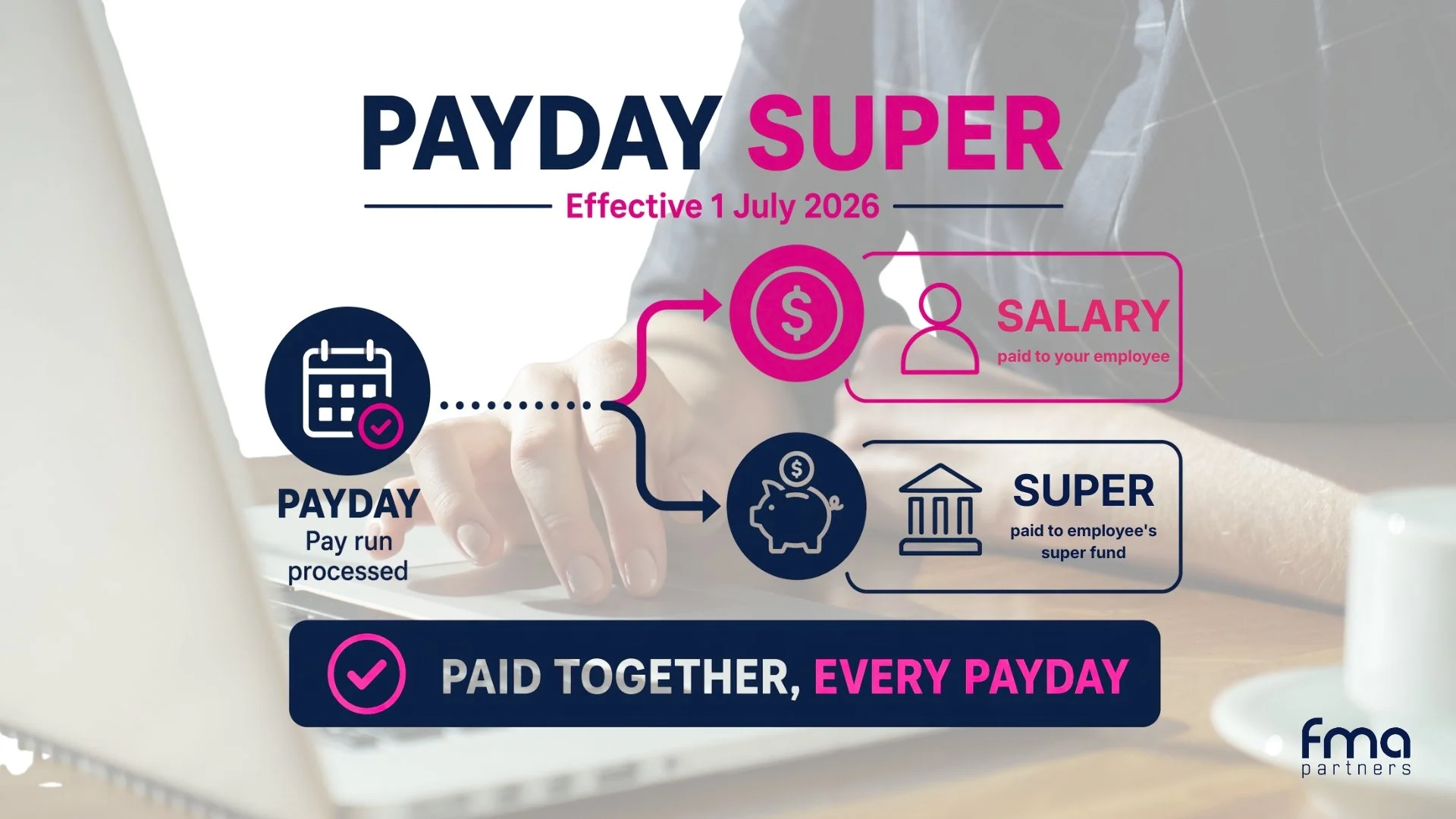
What Employers Need to Know Before 1 July 2026
From 1 July 2026, employers will need to pay super at the same time as processing payroll, rather than quarterly under the current rules. For many businesses, this will require changes to payroll processes, cash flow planning and internal controls.
The reforms are intended to improve the timeliness of super contributions, but they also create practical issues for employers, particularly around systems, employee onboarding, rejected payments and transition planning.
From 1 July 2026 to 28 July 2026, contributions received will first be applied to outstanding super guarantee obligations for the April to June 2026 quarter (Q4). Employers should consider whether it is preferable to finalise Q4 super contributions in late June rather than early July so they can start the new regime with a clean position. Check with your current clearing house on cut-off times if you wish to claim tax deductions for Q4 super payments in the 2026 financial year. For those using XERO, the cut-off is 24 June 2026 at 2pm.
Below we summarise the key changes, likely business impacts and practical steps to take now.
-
From 1 July 2026, super must be paid at the same time as wages, not quarterly.
Super will be calculated on a new definition of qualifying earnings (QE), which is a new term that brings together ordinary time earnings and other payments.
The maximum contribution base for which super is calculated now applies on an annual basis which will impact employers with highly paid employees or bonus arrangements.
Employers will have 7 business days from payday to ensure contributions reach employees’ super funds, which includes the 3 business days Superfunds are allowed to allocate or return contributions.
If super is paid late, the super guarantee charge (SGC) applies with interest and administration penalties, up to 50% of the outstanding SGC amount.
Employers will no longer lodge SGC statements; the ATO will identify late or missed payments itself by matching Single Touch Payroll data.
For pay periods from 1 July 2026 onwards, SGC amounts will be tax deductible (except for penalty components).
The ATO Small Business Superannuation Clearing House will cease operating on 30 June 2026.
-
Super will need to be funded each pay cycle rather than quarterly, which may require careful planning for cash flow and working capital.
Payroll teams will need to process, review and reconcile super more frequently, increasing administrative workload.
Super will be calculated on a new definition of qualifying earnings (QE), so payroll settings need to be reviewed and updated to ensure the correct superannuation is being calculated.
The maximum contribution base now applies on an annual basis. Employers with staff on higher salaries or large bonus arrangements will need to track the annual maximum contribution base across the full financial year, which may bring forward super costs and require closer payroll monitoring compared with the old quarterly cap timing.
Employers will need to report QE and super amounts through single touch payroll (STP), increasing the ATO’s visibility of underpayments and late payments.
Businesses will need reliable payroll and super systems to ensure contributions are processed and received within 7 business days of payday.
Employee onboarding will become more important, particularly collecting fund details quickly to avoid payment delays.
Rejected or returned contributions will need prompt follow-up, supported by clear internal ownership and exception alerts.
Employers using the Small Business Superannuation Clearing House will need to move to an alternative payment solution before it closes on 30 June 2026.
Businesses should review the 1 July 2026 transition period carefully, because payments made in July may first be applied against outstanding June quarter obligations.
Late or incorrect payments may create ATO penalties and interest exposure.
-
A transitional rule applies from 1 July 2026 to 28 July 2026. During this period, contributions received will first be applied to outstanding super guarantee obligations for the April to June 2026 quarter. Only after those obligations are fully met will contributions start being allocated to post 1 July 2026 qualifying earnings periods.
This transition rule is easy to overlook. Employers should consider whether it is preferable to finalise April to June 2026 super contributions in late June rather than early July so they can start the new regime with a clean position. -
Review the transition period carefully and decide whether June quarter contributions should be finalised before 1 July 2026.
Review payroll software and super payment processes to confirm they can support more frequent payments and reporting.
Check employee super fund details now, including member numbers and USIs, to reduce rejected contributions.
Map pay cycles and the 7 business day deadline for each payroll run, and model the working capital impact.
Review onboarding procedures so new starters are set up promptly with the correct fund details or default fund process.
Assign clear responsibility for rejected payments, data errors and resubmissions, including exception alerts.
Review payroll settings for higher paid employees to ensure the annual maximum contribution base is monitored correctly.
If you use the Small Business Superannuation Clearing House, move to an alternative solution before 30 June 2026.
Our team is here to support you and guide you through these changes. If you have questions regarding any of the content in this newsletter, please do not hesitate to contact your client manager, our office directly on 02 9540 6888 or via email at info@fmapartners.com.au.