
2026-27 Federal Budget Summary
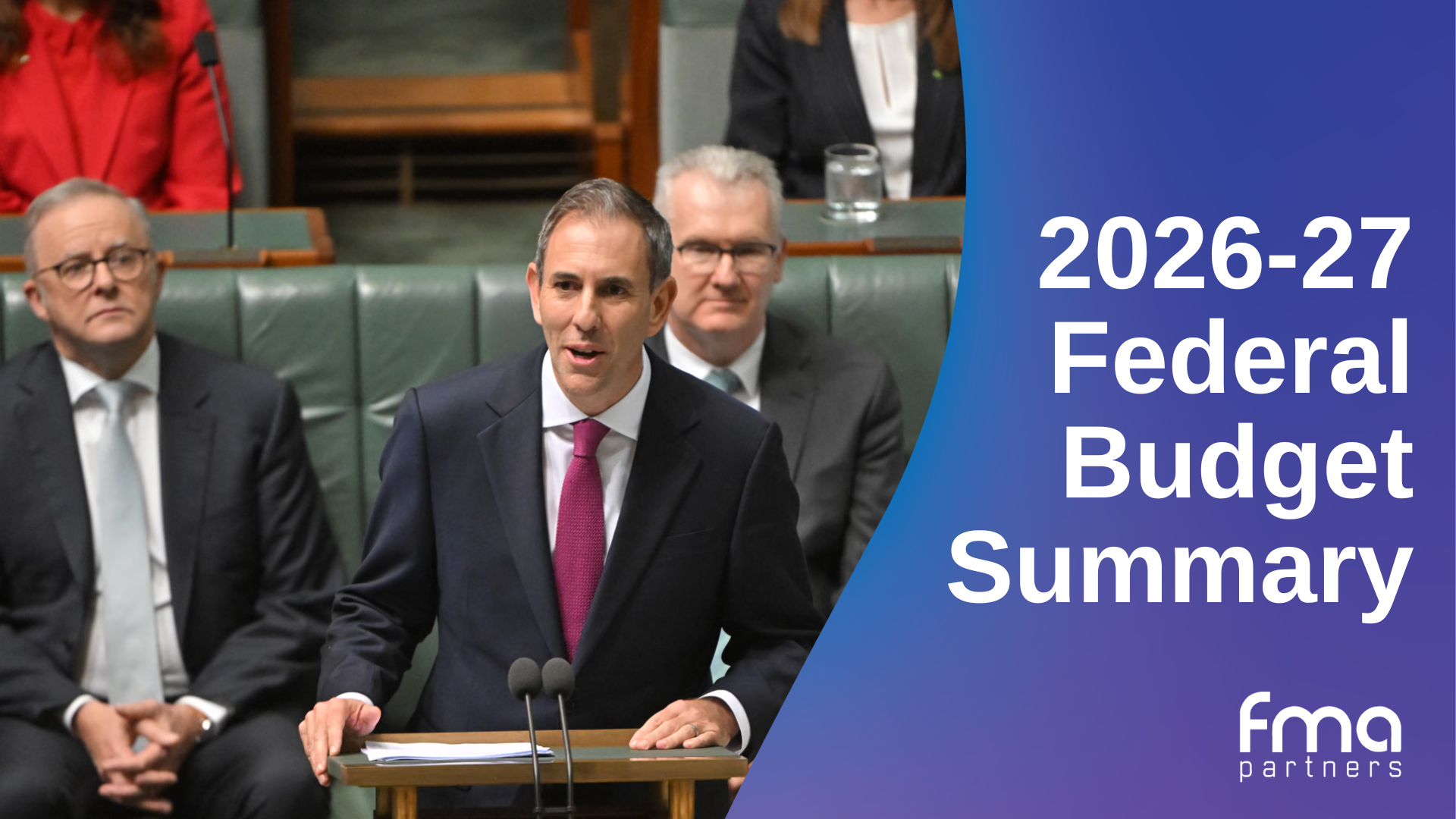
2026-27 Australian Federal Budget Summary
On Tuesday 12 May 2026 the Treasurer Jim Chalmers handed down the 2026-27 Federal Budget, framing some of the more significant announcements as part of a broader plan to help young Australians access the property market.
While acknowledging that the key to housing affordability is supply, the Government sees these changes to negative gearing and the capital gains tax (CGT) discount as being important pieces in solving Australia’s residential housing problem.
These changes however go far beyond the residential housing market, and with the additional proposed changes to the taxation of discretionary trusts, they are major proposed tax reforms which are aimed at reshaping investment and property taxation.
The Government has called this its most ambitious budget and if the proposed measures are implemented, the impact will be felt directly by a wide cross-section of Australian society, including individual taxpayers, investors, businesses, employers and those suffering from a disability.
The year’s budget has been released against a backdrop of significant economic challenges, including global fuel price shocks, persistent inflation, rising interest rates and growing concerns around housing affordability. These themes are reflected in the measures that have been announced by the Treasurer.
While the Government has announced some significant changes to the tax system, there were no major new superannuation measures announced. This is not withstanding that attention still remains on the upcoming payday super reforms and the Division 296 tax regime for balances above $3 million.
Key initiatives include:
-
Changes to the tax system to reduce existing concessions for property investors.
Extending the temporary ban on foreign purchases of established dwellings until 30 June 2029.
An investment of $2 billion to help local governments and state utilities build infrastructure to support new housing.
-
Strengthening Medicare where Urgent Care Clinics will receive additional funding to ease the pressure on GPs and hospitals.
Funds are allocated to list new medicines on the Pharmaceutical Benefits Scheme, including treatments for cystic fibrosis, kidney disease and various cancers.
An additional $25 billion in funding for public hospitals.
Reforms to the NDIS are expected to save $37.8 billion over the next four years. The scheme will be more focused on those with permanent and severe disabilities.
Private health insurance subsidies for Australians over 65 are being cut, with savings being used to fund aged care and dementia care units.
-
The defence budget will be increased by $53 billion over the next ten years.
-
A $14.8 billion package will be used to help Australia strengthen fuel supply.
A reduction in the fuel excise and heavy vehicle road user charge will continue to apply for three months from 1 April 2026.
Unless otherwise noted, the measures discussed below are only announcements at this stage with detail still to come on how the changes will be implemented. There is also no guarantee that they will be implemented as per the Government’s announcements (or at all).
Investors
-
The term ‘negative gearing’ refers to the situation where a rental property owner claims deductions for expenses associated with holding the property that exceed the rental income that is received in the relevant income year.
The loss that is generated from a rental property can typically be offset against other income (including salary, wages and net capital gains) to reduce overall taxable income or create a tax loss that can be carried forward to future years.
However, the parameters around negative gearing for residential property are set to change with the Government announcing that existing negative gearing rules will only be available in connection with “new builds” from 1 July 2027.
From this date onwards, losses from established residential properties that are acquired from 7:30pm (AEST) on 12 May 2026 will only be deductible against rental income or capital gains from residential properties. Excess losses will be carried forward to be offset against residential property income in future years.
‘New builds’ are residential properties which genuinely add to supply, such as dwellings constructed on vacant land and situations where existing properties are demolished and replaced with a greater number of dwellings.
Knock-down rebuilds or substantial renovations that do not increase supply will not be treated as new builds.
Properties acquired before 12 May 2026 will be exempt from the changes and the changes won’t apply to managed investment trusts or superannuation funds. Also, the changes don’t impact on other asset classes such as commercial properties or shares.
Resources
-
The CGT discount has enabled individuals, trusts and complying superannuation funds to reduce the taxable capital gain made on disposal of an asset that has been held for more than 12 months. The standard discount rate is 50% for trusts and individuals (although lower discount rates can apply to non-residents and temporary residents in some cases), with a 1/3 discount applying to superannuation funds.
However, from 1 July 2027 the Government is planning to revert to an indexation system based on the Consumer Price Index (CPI), much like the system that applied between 1985 and 1999. Indexation would only be available for assets that have been held for more than 12 months.
In addition to this, a minimum tax rate of 30% will apply to capital gains that accrue from 1 July 2027. There will be some exceptions to this for recipients of means-tested income support payments (eg, Age Pension, JobSeeker). There is little detail on the proposed minimum tax rate of 30% (to be imposed after indexation has been applied). The Budget Papers state that “a minimum tax rate on capital gains will reduce the incentive to hold onto an asset to release a gain when it is most tax advantageous and ensure a fair amount of tax is paid on capital gains, in line with lifetime income”.
Assets acquired before 20 September 1985 (referred to as pre-CGT assets) have historically been exempt from CGT, but this exemption will no longer apply from 1 July 2027.
Transitional rules will limit the impact of these changes for existing investments. The existing CGT discount and exemption for pre-CGT assets will continue to apply the gains that accrued before 1 July 2027. Taxpayers will need to determine the value of existing assets on 1 July 2027 to enable CGT calculations to be undertaken.
The CGT changes apply to all asset classes, including property and shares. The changes will apply to individuals, trusts and assets held by partnerships.
Only investors in new residential properties will be able to choose to apply either the 50% CGT discount or cost base indexation and the minimum tax. Income support payment recipients, including Age Pension recipients, will be exempt from the minimum tax.
Resources
Negative Gearing and Capital Gains Tax Reform
-
The Government has announced that a minimum 30% tax rate will apply to distributions made by discretionary trusts.
Discretionary trusts (often referred to as family trusts) have become a widely used structure for both investment and business activities. One of the key features of a discretionary trust is that the trustee is typically given the power to decide how to allocate income and capital gains made by the trust across family members and related entities.
This flexibility means that discretionary trusts can be used as an effective tax planning tool in many cases. For example, income distributed to an adult child could potentially be tax-free if the child has no other income and distributions are capped at the tax-free threshold for individuals.
However, the Government has announced that from 1 July 2028 onwards the trustee of a discretionary trust will pay a minimum 30% tax on the taxable income of the trust. Individuals and other non-corporate beneficiaries will receive a non-refundable tax credit for the tax paid by the trustee.
The marginal rate of 30% applies to taxable income in the range of $45,000 to $135,000. This means that beneficiaries would end up paying tax at a higher rate on the trust distribution (i.e. 30%) than they would on the rest of their taxable income (i.e. currently 0% or 16%).
The non-refundable credit will not be available for corporate beneficiaries (often referred to as bucket companies). It seems like the changes are being made partly to discourage trustees from distributing income to corporate beneficiaries.
We believe that tax planning will be even more crucial prior to year end trust distributions.
-
The Government has indicated that a limited form of rollover relief will be available for three years from 1 July 2027 for small businesses and others who wish to restructure out of a discretionary trust into a company or fixed trust. The rollover relief might help to minimise CGT and other income tax implications, but broader issues such as stamp duty will need to be carefully considered before any changes to an existing structure are implemented.
The minimum tax will not apply to fixed and widely held trusts, complying superannuation funds, special disability trusts, deceased estates and charitable trusts.
Some types of income such as primary production income, certain income relating to vulnerable minors, amounts that are subject to non-resident withholding tax and income from assets of testamentary trusts existing at 12 May 2026 will also be excluded.
Resources
Minimum tax on discretionary trusts
-
The Government will provide a concession in the foreign resident CGT regime for investment in the renewables sector.
The transitional arrangement will apply to foreign investors disposing of certain renewable energy infrastructure assets from the start date until 30 June 2030.
-
The Government will expand the scope of existing tax incentives which relate to venture capital limited partnerships and early stage venture capital limited partnerships.
Business
-
The Government has announced that the cost threshold for the purpose of applying the instant asset write-off for small business entities will be permanently increased to $20,000 from 1 July 2026.
The instant asset write-off allows eligible small business entities with aggregated turnover of less than $10 million to claim an immediate deduction for the full cost of depreciating assets which cost less than a specified dollar threshold. While the default threshold is $1,000, higher temporary thresholds have been implemented on a year-to year basis since 2015, often leading to confusion and uncertainty.
A permanent increase in the cost threshold to $20,000 is welcomed news for small business taxpayers who will have a greater level of confidence when it comes to investing in new plant or equipment or upgrading business assets.
In order to qualify for the immediate deduction, the cost of the asset must be less than $20,000, after subtracting any GST credits that can be claimed.
The cost threshold applies on an asset-by-asset basis, so an immediate deduction could potentially apply to multiple assets that are purchased for less than $20,000 in a particular income year, even if the aggregated cost of those assets is $20,000 or more.
Assets that cost $20,000 or more can continue to be added to a small business pool.
We note that as a reminder, the threshold for the current income year that ends on 30 June 2026 had already been increased to $20,000.
Resources
Backing small businesses to grow, compete and build resilience
-
For income years commencing on or after 1 July 2026 the Government will re-introduce the loss carry-back regime, which allows companies with aggregated annual global turnover of less than $1 billion to carry back a tax loss and offset it against tax paid up to two years earlier.
The ability to carry back a loss will only apply to tax losses (not capital losses) and will be limited by the company’s franking account balance.
-
On 5 May 2026 the Government announced that the FBT exemption for electric cars would be gradually scaled back over the next few years.
The FBT exemption for electric cars was introduced in the 2022-23 income year as part of a broader initiative to reduce the cost of electric vehicles and increase uptake.
While the exemption has been phased out for plug-in hybrid electric vehicles from 1 April 2025 (with pre-existing arrangements still qualifying for the exemption in some cases), a full FBT exemption still applies to battery electric vehicles and hydrogen fuel cell electric vehicles that are provided as fringe benefits to employees if certain conditions can be satisfied.
However, the Government is planning to progressively reduce the scope of the FBT exemption on the following basis:
The FBT exemption will continue to operate in its current form until 31 March 2027.
From 1 April 2027 to 31 March 2029 the full FBT exemption will only be available if the car costs $75,000 or less. Electric cars above this threshold but costing less than the luxury car tax (LCT) threshold for fuel-efficient cars will receive a 25% FBT discount.
From 1 April 2029 all electric cars costing less than the LCT threshold will receive a 25% FBT discount.
The Government indicates that existing lease arrangements won’t be impacted by these changes.
When an electric car is provided to an employee and it qualifies for concessional FBT treatment under these measures it will still be necessary for employers to calculate the reportable fringe benefits amount, ignoring the application of the FBT exemption or discount. This can impact on other areas of the tax and social security systems.
Resources
-
Start‑up companies with aggregated annual turnover of less than $10 million that generate a tax loss in their first two years of operation will be able to utilise the loss to generate a refundable tax offset.
The offset will be limited to the value of fringe benefits tax and withholding tax on wages paid in respect of Australian employees in the loss year.
-
The Government will reform the Research and Development (R&D) Tax Incentive which provides a tax offset for eligible companies that undertake R&D activities.
While the Government is planning to increase the tax offset rate for core R&D expenditure, supporting R&D expenditure will no longer qualify and the minimum amount of expenditure that must be incurred in an income year to qualify for the offset will be increased from $20,000 to $50,000 (with some limited exceptions).
-
The Government will provide funding to the ATO to expand its pilot of dynamic PAYG instalment calculations.
From 1 July 2027, small and medium businesses will be able to opt in to reporting and paying PAYG instalments monthly and will be able to use an ATO-approved calculation that is embedded in accounting software to calculate and vary instalments.
Superannuation
The Government did not announce any new major superannuation measures in the Budget.
Nevertheless, the super industry has enough big changes scheduled from 1 July 2026 for the following measures (as already legislated):
Payday super reforms that require employers to pay super guarantee (SG) contributions to employees within seven business days of the employee’s payday; and
The Division 296 regime for superannuation account balances above $3 million. Note that taxpayers expecting to be impacted by Division 296, and considering whether to withdraw funds from super, will now need to also consider the implications of the proposed changes to the CGT discount in the 2026–2027 Budget for those assets once outside super.
We note that complying superannuation funds, including self managed superannuation funds (SMSFs), are not anticipated to be directly impacted by the proposed removal of the 50% CGT discount. Rather, complying super funds (including SMSFs) are expected to continue to receive a CGT discount percentage of 33 1/3%.
Individuals & Families
-
The Government will provide a $250 ‘Working Australians Tax Offset’ from the 2027–28 income year.
The offset will be a permanent feature of the tax system and is aimed at taxpayers who derive income from work, such as employees who receive salary or wages and sole traders who carry on a business.
The offset basically operates to increase the effective tax-free threshold for income derived from work by nearly $1,800 to $19,985 (or up to $24,985 for workers eligible for the Low Income Tax Offset).
Resources
New tax cuts for Australian workers
-
During the 2025 federal election campaign the Labor party committed to introduce a $1,000 instant tax deduction for work-related expenses. On 20 April 2026 Treasury released draft legislation on this proposal for public consultation.
The key feature of the proposal is that Australian residents will be able to claim a standard deduction from the 2026-27 income year onwards for work-related expenses, with the deduction being capped at the lower of $1,000 and the individual’s assessable labour income. The normal substantiation rules would not apply when claiming the standard deduction.
Charitable donations, union fees and fees relating to professional association memberships would be claimed on top of the standard deduction.
Taxpayers who have incurred more than $1,000 in qualifying work-related expenses can instead choose to claim their actual expenditure as a deduction, but will need to substantiate these expenses.
The draft legislation contains some other proposed changes to the tax system including:
Depreciating assets that are mainly used to generate labour income won’t qualify for the low-value pooling rules.
Modified rules will apply to determine the tax impact on the sale of assets used in producing labour income.
An FBT exemption that currently applies when certain work-related items are provided to employees under a salary packaging arrangement will be removed.
Resources
$1,000 instant tax deduction to deliver lower, simpler taxes for 6.2 million workers
Instant tax deduction – exposure draft
-
Legislation has already been passed to ensure that the 16% tax rate on taxable income between $18,201 and $45,000 will drop to 15%. The rate will then drop to 14% from 1 July 2027.
This was announced in the 2025-26 Federal Budget.
Resources
-
The Government will increase the Medicare levy low‑income thresholds for singles, families, and seniors and pensioners.
The threshold for singles will be increased from $27,222 to $28,011.
The family threshold will be increased from $45,907 to $47,238.
For single seniors and pensioners, the threshold will be increased from $43,020 to $44,268.
The family threshold for seniors and pensioners will be increased from $59,886 to $61,623.
The family income thresholds will increase by $4,338 for each dependent child or student, up from $4,216.
Government and Regulators
-
The Government will provide $86.3 million over four years to help detect and prevent fraud in the tax system.
The Government will also strengthen the ATO’s ability to combat fraud by tax agents and other intermediaries. The ATO will be given powers to pause the recovery of tax debts of taxpayers who are victims of fraud by tax intermediaries, and waive those debts in appropriate circumstances, and to recover the debts from the tax intermediaries.
The ATO will undertake additional targeted compliance activities to further address fraud in the system, including in relation to the R&D Tax Incentive.
The Economy
-
The conflict in the Middle East has triggered substantial economic and energy disruptions across the world, driving global inflation higher, global growth lower, and compounding uncertainty and volatility. The impacts on the Australian economy will be felt for some time.
-
Higher inflation is expected to impact on growth in real incomes and household consumption.
As a result, growth in the Australian economy is forecast to slow from 2.25% in 2025-26 to 1.75% in 2026-27.
Growth in the Australian economy is expected to increase to 2.25% in 2027-28.
-
The budget deficit for 2026–27 is forecast to be $31.5 billion, which represents an improvement of $2.8 billion compared to the Mid-Year Economic and Fiscal Outlook (MYEFO).
The budget is projected to return to balance in 2034–35 and a surplus of 0.8% of GDP in 2036–37.
-
Gross debt is estimated to reach $1,051 billion (that’s over $1 trillion) at 30 June 2027. This represents 34% of GDP.
This figure is expected to increase to $1,249 billion (35.6% of GDP) at 30 June 2030.
Net debt in 2026–27 is expected to be 19.9% of GDP.
Interest payments on Australian Government Securities are estimated to be $27.7 billion in 2026–27, increasing to $40.4 billion by 2029–30.
-
The unemployment rate has been broadly stable over the last year and is expected to remain relatively low by historical standards.
The unemployment rate is expected to rise gradually from 4.25% in the June quarter 2026 to 4.5% in the June quarter 2027.
Employment is forecast to grow by 1.5% through the year to the June quarter 2026 and the June quarter 2027 and 1.75% through the year to the June quarter 2028.
-
The Wage Price Index is forecast to grow by 3.25% through the year to the June quarter 2026, before increasing to 3.5% through the year to the June quarter 2027 and the June quarter 2028.
The recent increase in inflation is expected to result in a decline in real wages over 2025–26. Real wages are forecast to grow again in 2026–27 and 2027–28 as inflationary pressures ease.
-
Headline inflation is forecast to be 5% through the year to the June quarter 2026.
Headline inflation is forecast to decline to 2.5% by the June quarter 2027, but this is based on the assumption that global oil prices will ease over 2026-27, which remains to be seen.
If you have queries regarding any of the content in this newsletter, please do no hesitate to contact our office directly on 02 9540 6888 or via email at info@fmapartners.com.au. Our team is here to support you and guide you through these changes as you consider your next steps.

Disclaimer: The material and contents provided are informative in nature only. It is not intended to be advice and you should not act specifically on the basis of this information alone. If expert assistance is required, professional advice should be obtained. Please do not hesitate to contact the team at FMA Partners to discuss further.